Your Child’s Most Important Teacher is You
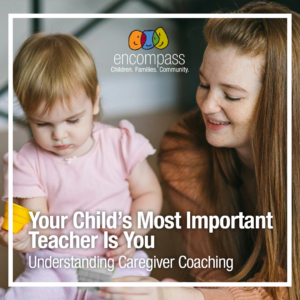 When you first hear about Early Support for Infants and Toddlers (ESIT), you might imagine a therapist or developmental specialist working directly with your child during weekly home visits. While those interactions are certainly important, the most effective tool in early supports might surprise you: caregiver coaching.
At Encompass, we believe that caregivers are their child’s first, best, and favorite teacher. It isn’t just us. Research consistently shows that when caregivers are supported through coaching, children have more opportunities to learn throughout the day, and families gain the confidence and skills to support development long after a visit ends.
You don’t need specialized training in child development. You are the person who knows your child best, loves them most, and is there for the countless everyday moments where learning naturally happens.
For children from birth to age three, development takes place within the context of trusted relationships. Young children learn through interactions with the people who care for and love them every day. They also learn through repetition. A new skill doesn’t develop when a child practices it once. It develops when they have lots of opportunities to practice it over and over again in meaningful, everyday situations with those they feel safest with.
Think about all the moments that happen in a typical week: meals, diaper changes, getting dressed, bath time, story time, trips to the grocery store, playground visits, and bedtime routines. These may seem ordinary, but for young children they are the backdrop for learning how to communicate, move, express and manage emotions, problem-solve, and gain independence.
Imagine that we drop a blue marble into a jar every time an ESIT provider interacts with your child. Depending on your family’s schedule and needs, that might happen once a week, twice a month, or sometimes even less frequently.
Now imagine dropping a white marble into the jar every time you interact with your child. By the end of a single day, the jar could hold dozens of white marbles. By the end of a week, there might be hundreds.
When you look at the jar, it becomes clear who has the greatest opportunity to support your child’s development. The goal of coaching is to make those hundreds of white marbles count. That is why caregiver coaching is such an important part of early supports.
 Coaching is not about telling caregivers exactly what to do or handing them a list of instructions.
It is a collaborative process. During visits, caregivers and providers talk about what is going well, what feels hard, and what is most important to the family. Together they brainstorm ideas, try strategies within real-life activities, observe how the child responds, make adjustments, and practice.
Coaching is also not homework or an extra to-do list. The strategies fit into the routines you already have.
Every family is different. Every child is different. What works beautifully for one family may not fit another family’s routines, culture, priorities, personality, or daily life. Effective coaching means meeting families where they are and partnering with them to discover what works in their family, for their child.
Maybe your 20-month-old always seems to get frustrated and melt down at snack time because they cannot yet clearly communicate what they want.
During a home visit, you and your provider might observe the routine together. You may notice opportunities to pause before handing over a desired food, offer simple choices, or model a word or gesture for requesting. You practice while your provider offers support and feedback.
You and your provider might explore questions like these together: Is snack time happening when your child is overstimulated or tired? How is your child already communicating? With an eye gaze, a grab, a grunt, a cry, a point? Are there too many choices, or not enough? What form of communication might be next for your child’s development: a point, a sound, a word approximation?
The best use of time during that home visit is working through these questions together. You and your provider bring your knowledge together to support your unique child and family.
With caregiver coaching, the learning doesn’t stop when the visit ends.
Throughout the week, you have multiple opportunities each day to use those same strategies at breakfast, lunch, dinner, snacks, out in the community, and lots of moments in between. You begin noticing your child’s communication attempts, responding differently, and making small adjustments in the moment.
By the next visit, your child may be making new attempts to communicate. Just as importantly, you have gained confidence. You are learning to recognize your child’s cues, solve problems in real time, and continue supporting development even when a provider is not present.
And if there aren’t new attempts to communicate yet, that’s okay too. Together, you and your provider discuss, observe, experiment, and practice. Maybe a cue was missed. Maybe your child needs an intermediate step before learning the next skill. The confidence doesn’t just come from successes. It comes from learning more about your child, your own strengths, and the relationship you share. That relationship is the foundation for so much of a young child’s learning and development.
 That confidence matters.
Parenting a young child with developmental concerns can feel overwhelming. Caregiver coaching helps you see that you do not have to wait until the next appointment to support your child’s growth. You already have opportunities throughout the day, and growing skills and knowledge to leverage those opportunities.
With support, encouragement, and a few carefully chosen strategies, everyday moments become opportunities for learning. And it’s not just about meeting that next milestone, but also about deepening the relationship and sharing important moments.
When providers bring their knowledge of child development together with your deep knowledge of your child, powerful things can happen.
The goal of coaching is not simply to teach a child a new skill. It is to help you recognize the many opportunities you already have to support your child’s growth and strengthen the everyday interactions and relationships where learning happens.
And that is what makes you your child’s most important teacher.