You’re Already Doing So Much Right: How Encompass Helps Families See Their Own Strengths
 If you’ve spent any time on parenting social media, you know how loud it can get. Tips, warnings, milestone checklists, conflicting advice, all arriving in an endless stream, often leaving parents with one quiet, persistent question underneath all the noise: Am I doing enough? Am I doing this right?
For many families, that question isn’t just background noise. It can feel like a constant companion in their relationship with their child.
We recently had a young mother in our Early Support for Infants and Toddlers (ESIT) program. Her son had motor delays, and despite being a Physical Therapist herself (or perhaps because of it), the worry about those delays had tangled itself up with something deeper: a feeling that she just wasn’t measuring up. The flood of parenting advice and content hadn’t helped. Precious time with her son had become laden with strategies and measuring, and the beautiful, unique dance of their relationship had gotten lost in the noise.
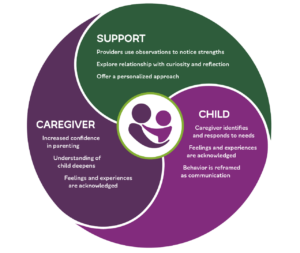 Along with developmental support for birth to 3-year-olds, our ESIT team offers an approach called Promoting First Relationships (PFR), a research-based program developed at the University of Washington that focuses on attunement between a caregiver and their child. PFR isn’t about handing parents a list of things to do differently. It’s built on the premise that most caregivers are already doing so many meaningful, loving, connective things with their children every single day, and sometimes they just need someone to help them see it. Every caregiver has the capacity to more deeply understand themselves and their relationship with their child.
One of PFR’s most powerful tools is video review. A trained facilitator films a short, ordinary interaction, playing on the floor, sharing a snack, reading a book, and then they watch it back together. With a supportive guide pointing out the moments of connection as they unfold, something remarkable often happens.
For this young mother, it happened the moment she first watched herself with her son.
 Her facilitator showed her, specifically and genuinely, all the ways she was already tuned in to her child. The way she followed his lead. The way he lit up when she spoke to him. The way she instinctively responded when he vocalized to her. She had been so focused on what she feared she was getting wrong that she couldn’t see that she was doing the most important things right.
She was moved to tears, not from sadness, but from relief and recognition.
Her son’s motor delay didn’t disappear that day. But something shifted. She began to see herself not as a mother falling short, but as her child’s most important relationship: his safe place, his most important teacher, the person who knows him best. The importance of caregiver/child attunement cannot be overstated; it is the foundation of all learning and every milestone.
 This is what building caregiver confidence looks like. Not a checklist. Not a perfect score on a milestone chart. A mirror, held up with honesty and kindness, reflecting what is always already there and using that to build upon. Supporting a caregiver’s confidence in their ability to support their child and to honor the vitalness of their attunement lasts a lifetime.
This is connection: the value at the heart of everything Encompass does. Our Early Supports team doesn’t arrive with answers. We show up to walk alongside you, to listen, to notice, and to remind you of your own strengths when the world has made them hard to hear.
If you have a child under three and think your family might benefit from ESIT services, we’d love to connect. We’re here, and we see you.
To learn more about the Encompass Early Support for Infants and Toddlers program, visit https://encompassnw.org/program/esit/ or call us at 425.888.3347 ext. 2303.
Resources: