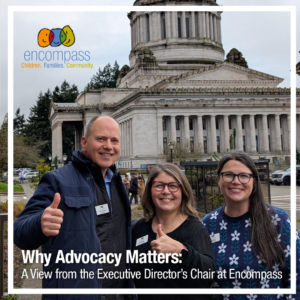
Why Advocacy Matters: A View from the Executive Director’s Chair at Encompass
 Advocacy isn’t separate from our mission at Encompass; it is essential to it. Every day, our teams show up for young children and families, navigating some of life’s hardest moments. We do this work because we believe everyone deserves the opportunity and the supports they need to thrive. But belief alone is not enough. Without strong public policies and adequate public investment, even the most dedicated organizations cannot meet the growing needs in our communities.
As an Executive Director, I’ve learned that advocacy is not optional; it’s part of our responsibility. When we speak up about what our families are experiencing, we help shape systems that work better for the people they are meant to serve. Right now, there are three advocacy priorities that are especially critical to Encompass and the communities we serve: protecting and strengthening the Early Childhood Education and Assistance (ECEAP) program, reforming government contracts for human services, and increasing Medicaid insurance reimbursement rates.
ECEAP: Investing Early, Building Futures
The Early Childhood Education and Assistance Program, known by the acronym ECEAP, is one of the most powerful tools we have to reduce inequities before they negatively affect children. At Encompass, we see firsthand how access to high-quality early learning changes the trajectory of a child’s life. Children arrive curious and capable, and with the right supports, they leave ready for kindergarten and beyond.
But ECEAP is about more than early learning. It supports whole families through health screenings, family engagement, and connections to vital resources. When funding doesn’t keep pace with need, or when program capacity is constrained, families who would benefit most are left waiting.
Advocating for ECEAP means advocating for prevention. It means recognizing that early investment saves costs later: socially, educationally, and economically. We must consistently elevate the voices of families and educators who know the value of this program because they live it every day.
ECEAP is severely underfunded, paying on average about 70% of the actual costs of the program. Underfunding ECEAP threatens our and others’ ability to provide this program at all. At Encompass, we believe that ECEAP should be available to every qualified child who needs it.
Government Contract Reform: Sustainability for Human Services
One of the less visible, but deeply impactful, issues facing nonprofits is how government contracts are structured. Human services organizations are often asked to do more with less under contracts that don’t fully cover the true cost of providing care.
Washington State did a study just last year that demonstrated this problem, which you can read about at: The Impacts of Contracting Structures on the Sustainability of Human Services Providers Study.
Most human services nonprofits, including Encompass, navigate complex contracts that may exclude indirect (administrative) costs, lag behind inflation, or require burdensome reporting that diverts staff time away from families. This is not a sustainable model. When contracts underfund essential services, organizations are forced to patch together solutions, rely on unrestricted fundraising, or stretch staff beyond reasonable limits.
Government contract reform is about fairness and effectiveness. Contracts should reflect real costs, allow flexibility to respond to community needs, and treat nonprofit partners as experts. Advocacy in this space isn’t self-serving; it ensures stability, consistency, and quality for the people who depend on these services.
When nonprofits are financially stable, communities are stronger.
Increasing Medicaid Rates: Valuing Care and Caregivers
Medicaid is a lifeline for millions of people, yet reimbursement rates often fall far short of the actual cost of care. This gap affects everything from waiting lists to staff retention to program viability because many health care providers will not accept Medicaid plans so that they can survive.
At Encompass, Medicaid-funded services touch some of our most critical work: supporting mental health, and interventions and therapy for children with developmental disabilities or delays. When rates are too low, we struggle to compete for qualified staff, retain experienced professionals, and expand services to meet demand. This isn’t because of inefficiency; it’s because the system undervalues care work.
Advocating for increased Medicaid rates is about valuing people—both those receiving services and those delivering them. It’s about recognizing that quality care requires a well-supported workforce, and that chronic underfunding undermines outcomes for everyone.
We are all Advocates
Advocacy can feel daunting, especially in a polarized environment. But from my perspective, it is one of the most important roles I hold as Executive Director. Our staff, families, and communities trust us to not only provide services but to speak up when systems aren’t working.
Advocacy doesn’t always look like providing public comment or testifying at the Capitol, though that matters. It also looks like sharing stories, building coalitions, educating policymakers, and staying persistent even when change is slow. Most importantly, it looks like centering the voices of those most impacted by policy decisions.
At Encompass, we will continue to advocate for ECEAP, for fair and functional government contracts, and for Medicaid rates that reflect the true value of care. Because when policy aligns with purpose, we can do more than respond to need—we can build a future where everyone has the opportunity to thrive.
Please join us. Learn more about Advocacy at Encompass by visiting our Advocacy Page. Follow along with our efforts and learn how you can speak up when the opportunity presents itself by signing up for advocacy alerts through Encompass using the form below.
Advocacy is how we turn compassion into lasting change.